
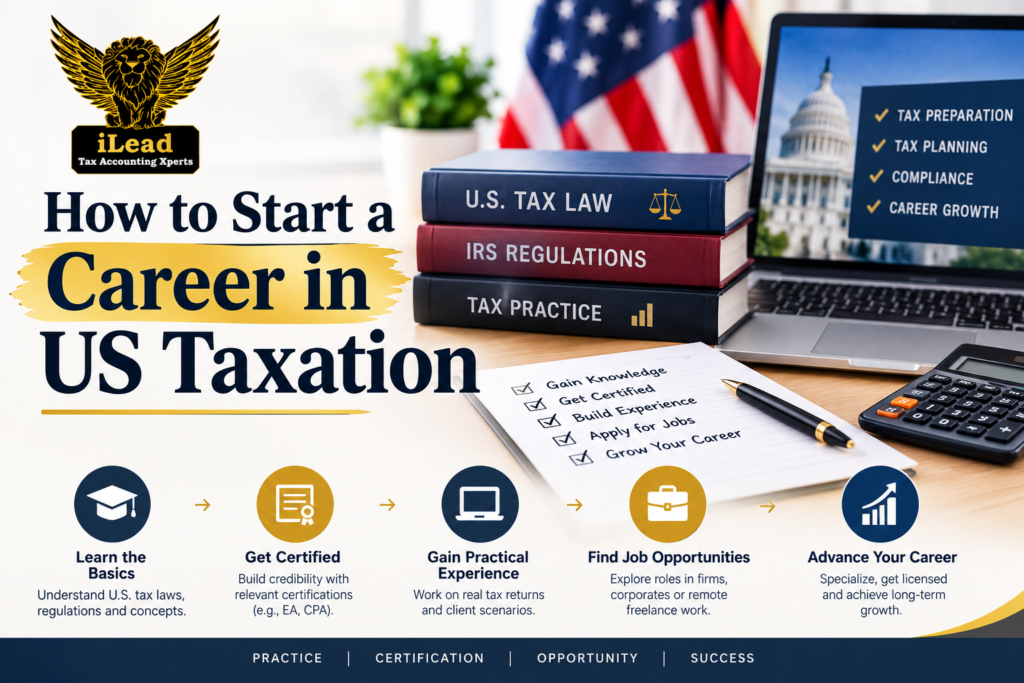
Starting a career in US taxation requires an understanding of federal tax rules, accounting fundamentals, and tax-return preparation. For graduates in India exploring this specialization, iLead Tax Academy offers training through its Enrolled Agent (EA) program and Real-Time Practical Training (RTP). Understanding the available career pathways, required skills, and professional qualifications can help you decide where to begin.
What Does a Career in US Taxation Involve?
US taxation professionals work with financial records, tax documents, and federal tax regulations to help individuals and businesses meet their tax obligations. Depending on their role and experience, their responsibilities may include:
- Preparing individual and business tax returns.
- Reviewing income, expenses, deductions, and credits.
- Checking documents for accuracy and completeness.
- Applying relevant tax rules to financial information.
- Supporting tax compliance and responding to tax-related queries.
Some professionals specialize in individual taxation, while others focus on business returns or representation before the Internal Revenue Service (IRS). Your preferred area can influence the skills and qualifications you pursue.
What Skills Do You Need to Start a Career in US Taxation?
You do not need to master every tax rule before beginning. Build a strong foundation first, then develop specialized knowledge.
1. Accounting Fundamentals
Understand income, expenses, financial records, and basic financial statements. These concepts help you interpret the information used during tax preparation.
2. Knowledge of US Tax Laws
Learn about federal tax requirements, filing statuses, deductions, credits, and individual and business taxation. Because tax regulations change, you must also know how to consult current IRS publications, forms, and instructions.
3. Tax Preparation and Software Skills
Tax professionals use digital systems to organize information and prepare returns. Familiarity with relevant tax preparation software and accounting tools can help you understand practical workflows.
4. Analytical Thinking and Attention to Detail
Accurate tax work requires checking calculations, identifying missing documents, and spotting inconsistencies. Strong analytical skills help you interpret financial information carefully.
5. Communication and Professional Ethics
Tax professionals must communicate clearly, handle confidential financial information responsibly, and maintain accurate records. Professional ethics and data security are essential throughout the process.
Which Qualification Can Help You Enter US Taxation?
One pathway worth exploring is the Enrolled Agent (EA) credential.
An Enrolled Agent is a federally authorized tax practitioner who has earned the privilege of representing taxpayers before the IRS. EAs have unlimited representation rights before the IRS, subject to applicable professional requirements.
The examination-based route generally involves these steps:
- Obtain a Preparer Tax Identification Number (PTIN).
- Register for the Special Enrollment Examination (SEE).
- Pass all three examination parts: Individuals, Businesses, and Representation, Practices and Procedures.
- Apply for enrollment and complete the required suitability check.
Candidates generally have three years to pass all three examination parts. Always check the official IRS EA guidance for current requirements and examination arrangements.
EA training can help candidates study the syllabus systematically. iLead Tax Academy offers EA training with tax lectures, study materials, practice questions, and doubt-clarification support.
Why Is Practical Tax Preparation Training Important?
Understanding tax concepts and applying them to actual tax-return workflows are different skills. Practical exercises help learners interpret source documents, identify relevant information, and understand how individual and business returns are prepared.
For example, individual tax preparation involves Form 1040, while business tax workflows may involve Forms 1065 or 1120. The appropriate forms depend on the taxpayer and business structure.
iLead Tax Academy offers Real-Time Practical Training as an additional learning option for EA and CPA aspirants. Its program includes practical work involving individual and business tax returns under expert review.
How Should You Start Learning US Taxation?
Follow a structured approach:
- Assess your foundation: Review your accounting knowledge and identify gaps.
- Learn tax fundamentals: Start with individual taxation before progressing to more complex topics.
- Choose a pathway: Decide whether to focus on tax preparation skills, pursue the EA credential, or explore another relevant specialization.
- Practise regularly: Work through sample documents, tax calculations, and return-preparation exercises.
- Compare training options: Check the syllabus, practical exposure, study resources, learning format, and support available.
Avoid choosing a course solely because of career or salary promises. Focus on the skills you will develop and whether the program aligns with your goals.
Conclusion
Starting a career in US taxation involves building accounting fundamentals, understanding federal tax rules, and practising how tax returns are prepared. The EA credential is one pathway to consider if you want to specialize in US taxation and qualify for IRS representation rights.
Explore your options carefully, compare training programs, and choose a learning path that matches your current knowledge and career goals.