
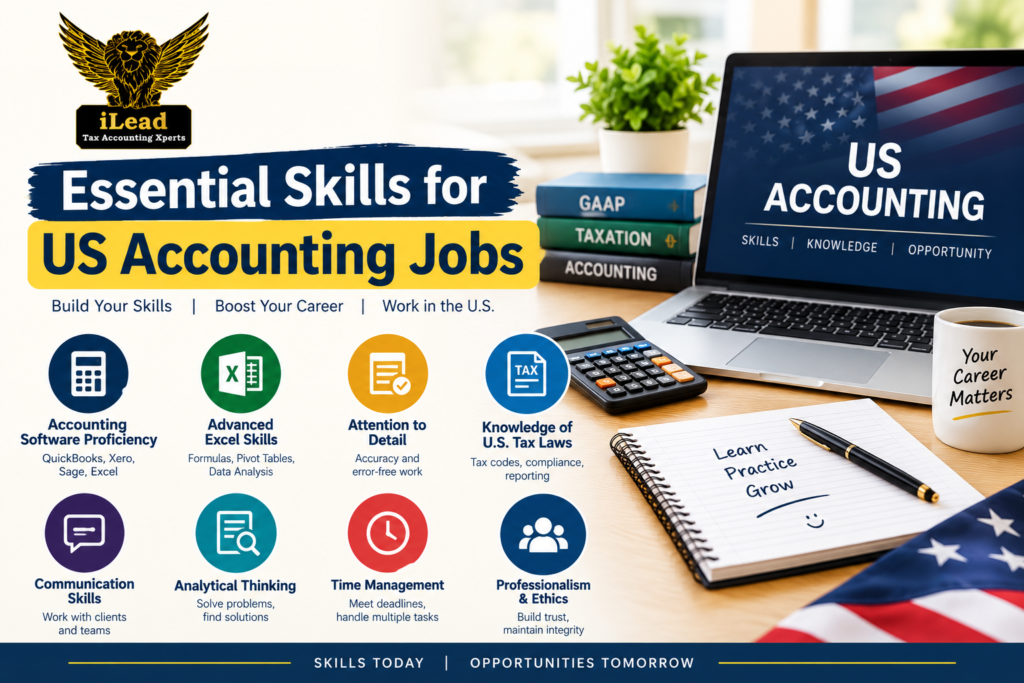
The essential skills for US accounting jobs include accounting fundamentals, bookkeeping, financial reporting, accounting software proficiency, and analytical thinking. As accounting workflows become increasingly technology-driven, professionals also need to understand data accuracy, compliance, and digital tools. iLead Tax Academy offers training in areas such as QuickBooks Online, US accounting, and payroll that learners can explore while building these skills.
What Skills Do You Need for US Accounting Jobs?
US accounting roles involve more than recording transactions. Depending on the position, professionals may maintain financial records, reconcile accounts, process payroll, prepare reports, or support tax compliance. Building the following skills can help you understand the work involved and identify areas for further learning.
1. Accounting Fundamentals and Bookkeeping
Bookkeeping is the foundation of many accounting workflows. It involves recording transactions, organizing financial documents, categorizing income and expenses, and maintaining accurate records.
You should understand:
- Debits and credits.
- Accounts payable and accounts receivable.
- General ledger entries.
- Bank and account reconciliation.
- Basic financial statements.
These fundamentals help you understand how individual transactions contribute to a company’s overall financial position.
2. QuickBooks Online and Accounting Software
Accounting software helps businesses manage transactions, invoices, expenses, and financial records more efficiently. QuickBooks Online is one tool used for bookkeeping and accounting workflows.
Practical knowledge can include creating invoices, recording expenses, reconciling bank accounts, and generating reports. iLead Tax Academy offers QuickBooks Certified ProAdvisor Online Training for learners interested in developing their QuickBooks Online skills.
Remember that completing a training program and earning a software certification are separate steps. Check the applicable certification requirements before describing yourself as certified.
3. US Taxation and Compliance
Accounting professionals working with US businesses may encounter federal tax documents, tax-related transactions, and compliance requirements. Understanding basic US taxation can help you recognize how tax obligations affect financial records.
The depth of knowledge required depends on the role. A bookkeeping position may involve organizing records, while specialized tax preparation requires more detailed knowledge of applicable tax rules and return requirements.
Learners interested in deeper tax specialization can explore the Enrolled Agent (EA) pathway, which focuses on US federal taxation.
4. Payroll Processing
Payroll involves calculating employee compensation, accounting for applicable deductions and withholdings, maintaining payroll records, and understanding reporting obligations.
Accuracy is particularly important because payroll errors can affect employees and employers. Familiarity with payroll calculations, compliance procedures, and recordkeeping can help you understand this area of accounting.
iLead offers payroll-related training options, including the Fundamental Payroll Certification (FPC) and Certified Payroll Professional (CPP) pathways.
5. Financial Reporting and Data Analysis
Financial reporting turns accounting records into information that helps businesses evaluate performance. Professionals need to understand reports such as the income statement, balance sheet, and cash flow statement.
Beyond preparing reports, analytical thinking helps accountants identify unusual changes, investigate discrepancies, and explain what the numbers mean.
Technology and AI are also changing accounting workflows. Industry research highlights the growing importance of data analysis and technology skills, while professional judgment remains essential for reviewing results and identifying errors. <Cite refs={[“turn326201search4″,”turn326201search5”]}/>
Which Skills Should Beginners Learn First?
You do not need to learn every accounting specialization at once. A practical learning sequence is:
- Build accounting fundamentals: Understand transactions, debits, credits, and financial statements.
- Practise bookkeeping: Learn how transactions are recorded and reconciled.
- Develop software skills: Work with accounting tools and practise common workflows.
- Explore a specialization: Consider payroll, US taxation, or financial reporting based on your interests.
- Strengthen analytical skills: Practise checking records, investigating discrepancies, and interpreting reports.
When comparing training programs, review the syllabus, practical exercises, software coverage, and support available. iLead Tax Academy’s QuickBooks, EA, and payroll programs are options to evaluate if they align with your chosen specialization.
How Can You Demonstrate These Skills to Employers?
Knowing accounting concepts is important, but being able to apply them makes your skills easier to demonstrate.
Consider practising with sample transactions, reconciling a mock bank statement, creating an invoice, preparing basic financial reports, or working through a payroll scenario. Keep track of the tasks you can complete independently and identify where you need more practice.
Avoid claiming expertise in software or compliance areas you have only studied theoretically. Be prepared to explain your process, the checks you performed, and how you handled discrepancies.
Conclusion
Building skills for US accounting jobs starts with understanding accounting fundamentals and learning how financial records are maintained. From bookkeeping and accounting software to payroll and financial reporting, each skill contributes to a different part of the accounting process.
Choose your learning priorities based on the work you want to pursue, and strengthen your knowledge through practical exercises. With a clear plan, you can identify skill gaps and select training that supports your next career step.